
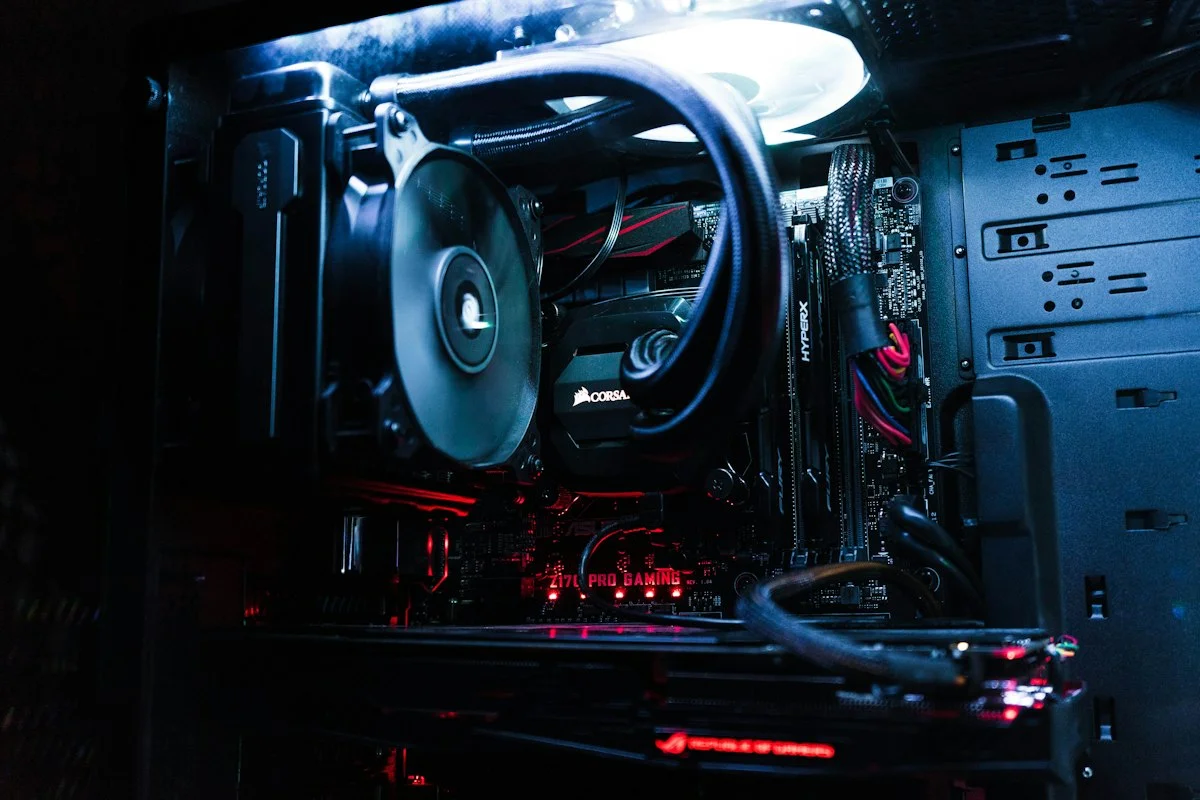
- Broadcom BCM2712 PCIe Topology: The Raspberry Pi Compute Module 5 (CM5) exposes native PCIe Gen2/Gen3 lanes from the BCM2712 SoC, eliminating the bottleneck of the standard Model B’s ribbon-cable adapter and allowing direct high-speed M.2 NVMe SSD or NPU accelerator attachment.
- High-Speed Hirose High-Density Connectors: CM5 utilizes standardized dual 100-pin Hirose DF40 connectors, maintaining backward mechanical footprint compatibility with CM4 carrier boards while unlocking 2.4GHz Cortex-A76 compute performance.
- Dual 4-Lane MIPI CSI-2 Vision Interfaces: Carrier boards leveraging the CM5’s dual 4-lane MIPI camera interfaces can ingest uncompressed 4K 60fps video streams from dual global shutter image sensors simultaneously for stereoscopic spatial robotics.
- Embedded Cluster Links: Cross-link with our cluster-on-a-module SBCs (Turing Pi vs. DeskPi) guide and our flagship RK3588 single board computer benchmark.
The standard Raspberry Pi 5 single-board computer is an exceptional tool for hobbyists and educational prototyping. However, in industrial automation, smart agriculture, and edge vision systems, the Model B’s fixed port layout, awkward side-exiting connectors, and fragile ribbon cables make commercial product integration impossible.
The Raspberry Pi Compute Module 5 (CM5) strips away consumer ports, packaging the quad-core 2.4GHz Cortex-A76 silicon, LPDDR4X RAM, and optional eMMC storage onto a compact 55mm x 40mm circuit board. By engineering custom or deploying off-the-shelf carrier boards, hardware developers can construct ruggedized, fanless edge AI appliances tailored precisely to mission requirements.
What Is a Raspberry Pi CM5 Carrier Board?
A CM5 carrier board is an application-specific motherboard that mates with the Compute Module 5 via Hirose high-density connectors. It breaks out physical interfaces—such as dual M.2 PCIe slots for NVMe and AI accelerators, dual Gigabit Ethernet, RS-485 serial ports, and industrial power inputs (9V–36V DC).
Evaluating carrier boards requires analyzing signal integrity, thermal dissipation, and industrial field bus support.
CM5 Carrier Board Architectural Comparison
The following engineering table outlines the primary carrier board categories available for commercial CM5 deployments:
| Carrier Board Architecture | PCIe Expansion Topology | Network & Field Bus | Power Regulation | Target Deployment |
|---|---|---|---|---|
| Official Raspberry Pi CM5 IO Board | Standard PCIe x1 Gen2/Gen3 slot | Single 1GbE RJ45 + 40-pin GPIO | 12V DC barrel jack input | Benchtop software prototyping |
| Industrial Dual-Ethernet Gateway (Waveshare) | M.2 Key-M (2280 NVMe SSD) | Dual 1GbE + RS-485 + Isolated CAN Bus | Wide 9V to 36V DC terminal block | DIN-rail industrial telemetry & SCADA |
| Edge AI Vision Dual-Slot Carrier | Dual M.2 (1x NVMe SSD + 1x Hailo/Coral NPU) | Single 2.5GbE RJ45 + Dual 4-lane MIPI | USB-C PD 15V / 20V regulated | Smart security cameras & robotics vision |
| Cluster Blade Node Carrier (Turing Pi 2) | Mini PCIe / onboard I2C backplane | 1GbE backplane routed to central switch | ATX 24-pin motherboard power | High-density Kubernetes micro-clusters |
PCIe Packet Switching vs. Native Lane Allocation
The primary constraint of the Broadcom BCM2712 processor is PCIe lane availability: the SoC exposes a single PCIe 2.0/3.0 root complex with limited lanes. If an edge carrier board requires both an M.2 NVMe SSD for local operating system storage and an M.2 NPU accelerator (such as a Hailo-8 or Google Coral), it must integrate an onboard PCIe Packet Switch (such as the ASMedia ASM1184e or Diodes PI7C9X2G).
A PCIe packet switch multiplexes the single upstream host lane into multiple downstream PCIe endpoints. While this slightly divides peak sequential bandwidth during concurrent disk writes, neural network inference operations are largely read-only, allowing full-speed AI acceleration without bottlenecking system storage.
Thermal Engineering in Industrial Enclosures
Under sustained multi-threaded workloads, the Cortex-A76 cores on the CM5 generate up to 10W of heat. In enclosed aluminum DIN-rail chassis without fan vents, thermal throttling occurs within 4 minutes, dropping clock speeds from 2.4GHz to 1.5GHz.
Industrial carrier designs incorporate copper thermal vias directly beneath the CM5 module, mating the top of the BCM2712 silicon to a solid CNC-milled aluminum heatsink block that acts as the outer enclosure wall. This conductive thermal path maintains operating temperatures under 65°C in 50°C ambient environments without moving parts.
Do not deploy fragile Raspberry Pi 5 Model B boards into commercial installations. Standardize on the Raspberry Pi CM5 mated to a ruggedized industrial carrier board featuring wide-input DC power (9V–36V), dual Gigabit Ethernet, and an onboard M.2 Key-M slot paired with a Hailo-8 NPU. It delivers enterprise-grade mechanical reliability, native PCIe signal integrity, and sub-20ms edge vision inference in a fanless footprint.