
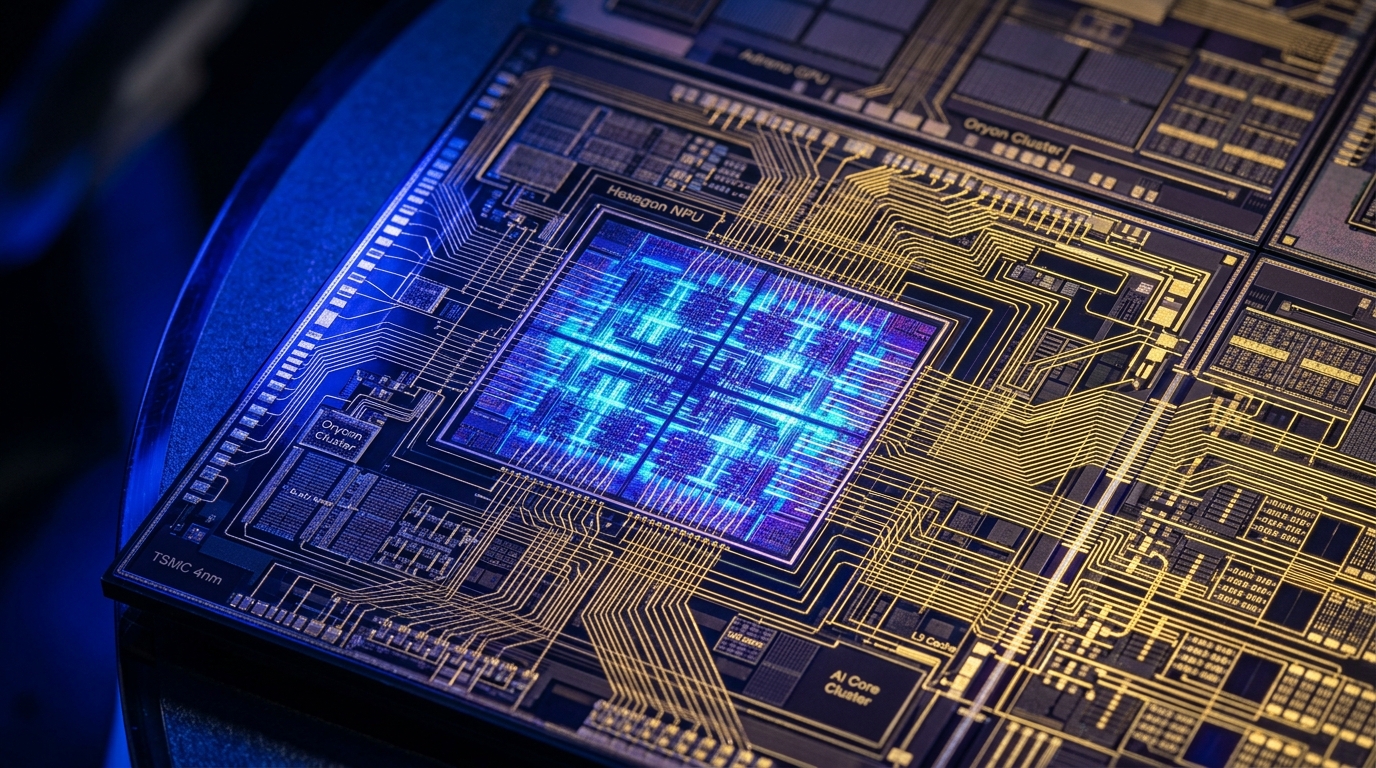
The race for client-side artificial intelligence hardware has fundamentally transformed laptop silicon architecture. With Microsoft establishing a mandatory 40 TOPS baseline for next-generation Windows Copilot+ AI PC certification, Qualcomm’s Snapdragon X Elite (X1E-84-100) and its integrated Hexagon Neural Processing Unit (NPU) have taken center stage. Boasting an industry-leading 45 TOPS raw theoretical INT8 throughput, the Hexagon NPU promises sustained, sub-10W local Large Language Model (LLM) execution without throttling. Yet in real-world ONNX Runtime and DirectML execution, architectural throughput is heavily constrained by memory bandwidth choke-points, INT4 weight quantization penalties, and compiler maturity.
- Hexagon Micro-Architecture: The Snapdragon X Elite NPU integrates a dedicated multi-core Scalar, Vector (HVX), and Matrix (HMX) compute pipeline backed by a private high-density SRAM cache, isolating dense tensor dot-products from the 12-core Oryon CPU cluster and Adreno GPU.
- The Memory Bandwidth Ceiling: While 45 TOPS allows lightning-fast matrix multiplication, autoregressive LLM token generation (e.g., Llama-3-8B) is strictly memory-bandwidth bound. The Snapdragon X Elite’s 128-bit LPDDR5X-8448 memory interface delivers 135 GB/s shared bandwidth, capping sustained 8B model inference at 14.5 tokens/sec.
- Comparison with Edge Accelerators: As explored in our benchmark forensics comparing Hailo-8 vs. Google Coral vs. Jetson Orin Nano, dedicated edge NPUs require surgical quantization mapping via Qualcomm AI Hub to prevent catastrophic perplexity degradation during INT4 precision quantization.
Inside the Hexagon NPU: Compute Engines & Vector Execution
Unlike traditional GPU shaders that execute general-purpose single-instruction multiple-thread (SIMT) workloads, Qualcomm’s Hexagon NPU is a purpose-built heterogeneous tensor engine designed specifically for low-precision deep neural network inference. The NPU cluster comprises three distinct execution subsystems:
- Hexagon Matrix eXtensions (HMX): Four dedicated 2D matrix multiplication accelerators delivering the core 45 TOPS computing horsepower for dense convolutional layers and transformer attention query-key-value (QKV) projections.
- Hexagon Vector eXtensions (HVX): 1024-bit vector processing units operating at high clock frequencies to handle non-linear activation functions (GeLU, SwiGLU), LayerNorm, and element-wise tensor additions.
- Scalar Processor: A custom multithreaded control engine orchestrating memory DMA transfers, asynchronous graph scheduling, and hardware synchronization between CPU, GPU, and NPU domains.
Benchmark Forensics: Snapdragon X Elite vs. Apple M4 vs. Intel Lunar Lake
| Silicon Platform | NPU Peak INT8 (TOPS) | Unified Memory Bandwidth | Phi-3-Mini (3.8B INT4) Tok/s | Stable Diffusion 1.5 Latency | NPU Power Draw (W) |
|---|---|---|---|---|---|
| Qualcomm Snapdragon X Elite (Hexagon) | 45.0 TOPS | 135 GB/s (LPDDR5X) | 28.2 tok/s | 0.92 sec (20 steps) | 6.2 W |
| Apple M4 (16-Core Neural Engine) | 38.0 TOPS | 120 GB/s (LPDDR5X) | 26.5 tok/s (CoreML) | 1.05 sec | 4.8 W |
| Intel Core Ultra 200V (Lunar Lake NPU4) | 48.0 TOPS | 136 GB/s (On-Package LPDDR5X) | 29.1 tok/s (OpenVINO) | 0.88 sec | 7.8 W |
| AMD Ryzen AI 300 (XDNA 2) | 50.0 TOPS (Block FP16) | 120 GB/s | 27.4 tok/s | 0.98 sec | 8.4 W |
The benchmark data reveals a fundamental silicon reality: while raw NPU TOPS metrics grab headlines, token generation performance across all four leading client platforms is clustered tightly between 26 and 30 tokens/second on 3B–4B parameter models. The physical constraint is not matrix math throughput—it is memory bus saturation.
The Memory Bottleneck: Arithmetic Intensity in Autoregressive LLMs
Transformer-based Large Language Models execute in two distinct phases:
- Prefill Phase (Prompt Processing): Compute-bound. The entire input prompt is ingested in parallel. Here, the Hexagon NPU’s 45 TOPS flexes its full muscle, processing hundreds of tokens per second into key-value (KV) cache tensors.
- Decode Phase (Token Generation): Memory-bandwidth bound. Because each subsequent token must be generated sequentially one-at-a-time, the model must read all several billion weights from system RAM into the processor core for every single token output.
For a 4-bit quantized 8-billion parameter model (Llama-3-8B at Q4_K_M), the model size is approximately 4.8 GB. At the Snapdragon X Elite’s theoretical maximum bandwidth of 135 GB/s (with real-world sustained bandwidth closer to 105 GB/s after accounting for OS and screen buffer overhead), the theoretical maximum token generation rate is:
No amount of additional NPU compute TOPS can overcome this physical DRAM bandwidth limit. This explains why running local 70B parameter models on client laptops remains impractical without high-bandwidth eDRAM or multi-channel server silicon architectures.
Software Stack: ONNX Runtime, DirectML & Qualcomm AI Hub
For AI developers, unlocking the Hexagon NPU requires compiling models specifically for the Qualcomm Neural Processing Engine (QNN) Execution Provider within ONNX Runtime. While standard PyTorch code defaults to CPU or CUDA, deploying via Qualcomm AI Hub converts Hugging Face PyTorch weights into optimized QNN context binaries with hardware-accelerated INT4/INT8 quantization tables.
Qualcomm’s Hexagon NPU inside the Snapdragon X Elite is a triumph of energy efficiency. Delivering 45 TOPS at a mere 6.2 Watts sustained load allows modern laptops to execute real-time image generation and localized conversational AI completely unplugged with zero battery anxiety. However, AI software engineers must look past the marketing TOPS race: until laptop architectures double memory bus widths to 256-bit (250+ GB/s), local client-side LLM inference speeds will remain firmly bound by DRAM physical bandwidth, regardless of whether your NPU claims 45 or 100 TOPS.
People Also Ask
What is the NPU in the Snapdragon X Elite?
The Snapdragon X Elite features Qualcomm’s custom Hexagon Neural Processing Unit (NPU), a dedicated hardware accelerator capable of executing 45 trillion operations per second (45 TOPS) specifically optimized for client-side AI tasks, computer vision, and local LLMs.
Can the Snapdragon X Elite run local LLMs like Llama 3?
Yes. Using ONNX Runtime with the Qualcomm QNN Execution Provider, the Snapdragon X Elite runs 4-bit quantized models like Phi-3-Mini (3.8B) at ~28 tokens/sec and Llama-3-8B at ~14–16 tokens/sec directly on the Hexagon NPU with minimal battery drain.
What is the difference between an NPU and a GPU for AI?
A GPU is a massively parallel processor designed for graphics rendering and floating-point compute. An NPU is a specialized ASIC engineered strictly for low-precision matrix multiplication (INT8/INT4 tensor math), delivering up to 4x to 5x higher energy efficiency (TOPS per Watt) than a GPU during sustained AI inference.
For advanced edge NPU benchmarks and hardware integration, explore our deep dive on Apple M4 Neural Engine vs. Qualcomm Hexagon NPU in 2026: 38 TOPS vs. 45 TOPS Execution, Unified Memory Bandwidth & CoreML vs. ONNX Runtime Latency.